Who Moved?~ Jen

IMG_20130325_161833

“Where is God?” my students used to ask me in religion class. Yeah, I taught religion. That’s a story from another lifetime.

Where two or three gather in my name, there am I with them.  So right here.

“But how do you know??!!”

Ok. At the worst moments of my life, when I was sick, hurt, stupid or angry, my mom and dad loved me. Sometimes they were thousands of miles away and sometimes they were hurting right there next to me, but they loved me. I never doubted it, even when I was angry at them. They love me.

And scripture tells us that God our Father loves us even more than our earthly parents.

“Well, then where is He, when babies die of cancer or someone kills a good person??”

He’s there, just like your mom or dad would be there, loving and grieving. But this life is ours to live, with all its imperfections. What happens to us here is a product of here. Perfect is not of this world.

“My life sucks. God’s not here. He doesn’t love me. No one loves me.”

I never knew what to say to that one, beyond a silly game of “Yes, He does” and “No, He doesn’t”. Teenagers can be stubbornly sad sometimes and I figured it was not my lesson to teach. God has His own time.

The other night I went to family faith formation at church. Deacon Pat was supposed to be talking about baptism, but Deacon Pat likes to talk, so we followed a curvy path. For those who don’t know, a deacon in the Catholic church is an ordained minister dedicated to service. Pat is a humble and approachable servant of God. I’m not sure, but he sounds like he’s originally an East Coast guy. Maybe Philly. Lots of big hand movements and that “What, are you kidding me?” tone of voice. At one point he started talking about folks who wonder where God has gone.

Look”, he said. “I never understand people who say ‘God left me. God doesn’t love me’. I don’t get it. If I’m standing here next to God, and then I feel like God is suddenly far away, who moved? Who moved? God moved? No, I moved. You want to be closer to God? Move back.”

And there you have it. God doesn’t stop loving. God doesn’t move. I move. You move. We move.

Move back. Wouldn’t Advent be an amazing time to do that?

2+2=___. Explain Your Answer ~ Jen

IMG_20131025_073421Gabriel is a math whiz.

But he got a lower than normal score on his first math test this year. Even though his school is private, they have adopted the Common Core. Some things on the test looked odd to me, so I decided to look up the Grade 2 Common Core math standards.

One page. Basic math. Awesome. My kid needs to learn to add and subtract and dabble in multiplication. He needs to further his understanding of the base-ten system, which means he needs to understand that 853 is 8 hundreds, 5 tens and 3 ones.

Great.

But here’s what I am seeing in his homework. Problems like this:

Another way to write 245 is:

_____100s   +   _____10s  +   _____1s    Explain your answer.

Uh. Explain what? It’s a fact. What is there to explain? That 245 is 2 hundreds, 4 tens and 5 ones? Didn’t he just demonstrate his understanding by getting the question correct?

And then this, on his math test:

Which number sentence uses a ten to get the answer to 7+7?

a. 10+7=17               b. 7+7=14                            c. 10+4=14                           d. 9+8=17

He got it wrong. His teacher gave him a chance to earn back half points if he corrected his mistakes, so we went over it.

I had him read the question out loud to me.

“What is the question asking you?” I asked.

“I don’t know” he said.

The question wants him to demonstrate that he knows that 14 is 1 ten and 4 ones. And at the same time, it wants to test his basic math skills, that 7+7 is 14, and 14-10 is 4. All of these things are apparent in the CC Math standards for 2nd grade.

“Well, how did you choose your answer then?”

“I looked at the problem. There was no answer to 7+7, so I picked the one that told the answer to 7+7.”

“Ok. How many tens are there in 14?”

“One.”

“How many ones?”

“Four.”

“The question wants you to pick the sentence that uses those two numbers.”

“Oooohhh.” Pause. “Why?”

I don’t know.

When I was in school—back when the US scored much higher in the world rankings in math and science—we just learned math. Add, subtract, multiply and divide—and the multiply and divide didn’t happen until third grade. I remember this because I was the second child in Mrs. Alexander’s class to master my tables. I got a cool pen.

Our math wasn’t convoluted and complicated by silly questions like “Explain why 2+2=4”.

But now, 33 years later, we have this: a math question that tests reading comprehension and critical thinking, which is dodgy when we’re talking about 7 year olds who are still evolving readers.

What it doesn’t test is math.

There is nothing wrong with common core. I have read the second grade standards and the high school ELA standards. They are a list of stuff that good teachers teach anyway. Maybe using new-fangled vocabulary, but that’s it.

The standards are not the problem. Having basic common standards is also not the problem.

The problem is—and always has been—the testing. The testing has never worked because it has never given teachers useful data. Every year, we sat down with our test scores and the test and tried to figure out what we needed to do to improve. And every year we hit some variation of this problem:

I’d have a class of 38 11th grade students. Almost 60% of those were English Language Learners; almost 80% of them would be reading two or more levels below grade level. The reading piece was Young Goodman Brown, by Nathanial Hawthorne, with a lexile (reading) level of 1270 (you can see the actual test questions here, on page 7). The lexile level for 11-12 grade tops out at 1210. So this reading piece is college level.

My students did not test well on this piece. Duh.

Is it because they don’t understand what the questions were asking them?

Or it is that they couldn’t comprehend the dang thing to begin with? That we lost them at the first paragraph, which goes like this: Young Goodman Brown came forth at sunset into the street at Salem village; but put his head back, after crossing the threshold, to exchange a parting kiss with his young wife. And Faith, as the wife was aptly named, thrust her own pretty head into the street, letting the wind play with the pink ribbons on her cap while she called to Goodman Brown.

So at the end of the day, what did I know: that my kids tested poorly on this piece, which I could have predicted with 100% accuracy before they even started. Because 11th graders reading at a 9th grade level aren’t going to handle a college level reading piece very well.

What I couldn’t know from this test is their mastery of 11th grade ELA standards. Which is supposed to be the whole point of the testing.

Bad data. Math scores that tell us more about reading than math. Reading scores that tell us what we already know but have no systems in place to address. Millions and millions and millions of dollars.

For what?


Caramel Apples and Popcorn Balls ~ Jen

When I was growing up, Opal and Stubby lived down the street. They were part of the wave of Iowa immigrants that gave Long Beach, Ca the nickname “Iowa by the Sea”. From the collector’s plates lining the kitchen walls to the 1950s Ford truck parked in the driveway to the homecooked meals, they were a slice of Midwestern farm life living three doors down.

Opal didn’t give out candy at Halloween. Instead, she’d work for two days to prepare a giant basket of caramel apples and popcorn balls. I’d show up at the backdoor to “help”, which meant I got an early taste of the treats. I lost my first tooth after biting into one of her apples when I was six.

I remember that it was hard work to make caramel apples. So the first time I tried to make caramel apples, I was a bit perplexed by how fast it went. Melt a bag of caramels. Check. Ten minutes later I was dipping apples. Why did it take Opal so long, I thought. What’s the big deal?

Opal must have had a good chuckle up in heaven, because the caramel ran right off those apples and puddled on the cookie sheet.

This year, I was determined to get caramel apples right. And I wanted to try popcorn balls. So I searched for a caramel apple recipe that did not start with a bag of Kraft caramels and turned to Paula Deen for a popcorn ball recipe. Here’s what happened.

We made caramel from scratch. It has to come up to soft ball stage on the stove, which is 240 degrees. That’s 32 degrees above boiling. It took an hour of constantly stirring. AN HOUR. Worth it, thankfully. The caramel was a rich, deep brown color and smelled heavenly. It coated the apples and stuck.

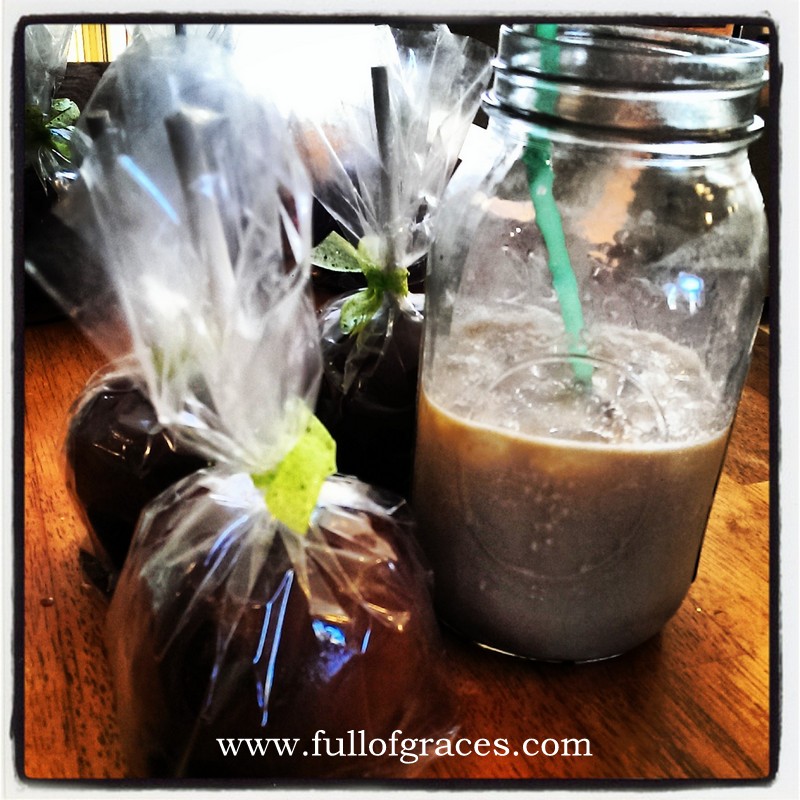
These are my apples and a glass of Door county Christmas iced coffee.

Then we turned to the popcorn balls. And discovered that the recipe required us to bring the sugar syrup up to hard ball stage. That’s 250 degrees. Good Lord, Paula. We almost quit.

Then we ate some cooling caramel and found our second wind. Forty five minutes later, we had hard ball stage sugar syrup.

We had two huge bowls of popcorn, a pot of beyond boiling hot syrup and a recipe that urged us to “move quickly to form the balls”. It was not pretty, what happened next. In case anyone’s wondering, 250 degrees is for-the-love-of-God hot and I have the burned fingertips to prove it.

IMG_20131015_131424

Out of curiosity, I looked up the Karo syrup popcorn ball recipe. Much easier. Oh, and the Karo recipe says “using plastic bags to protect hands from hot syrup, form popcorn into balls”.

You hear that? That’s Opal, still laughing.

The caramel apple recipe is a keeper. The popcorn ball recipe was good, but next time, I will start with Karo syrup and end with plastic bags and see if it all tastes the same.

Happy Fall!

If you ignore that she's perched on the edge of the counter, isn't she the cutest helper ever???
If you ignore that she’s perched on the edge of the counter, isn’t she the cutest helper ever???

Caramel Apples from Scratch (courtesy of The Baker Chick)

Popcorn Balls (courtesy of Paula Deen)

Popcorn Balls (www.karosyrup.com)

All-natural sunscreen via wellnessmama.com

½ cup sweet almond or olive oil

¼ cup coconut oil

¼ cup beeswax

2 Tbsp Zinc Oxide (this is a non-nano version that won’t be absorbed into the skin.  Be very careful not to inhale the powder.  Wear a mask if necessary.  2 Tbsp will make the sunscreen 20 SPF.  More can be added.)

Optional:  1 tsp Vitamin E oil

Optional:  2 Tbsp Shea Butter or Cocoa Butter

Optional:  Essential Oils or Vanilla Extract

Directions:

  1. Combine all ingredients except essential oils in a pint sized glass jar.  I decided to use a canning jar that I have designated just for making lotions.  You could also re-use tomato sauce jars, pickle jars, olive jars… be creative!
  2. Fill a medium saucepan with a couple inches of water and place over medium flame.
  3. Place glass jar in pan.
  4. As the water heats up, the ingredients in the jar will begin to melt.  Stir or swirl occasionally to incorporate.  Be careful, the jar will get hot, too!
  5. When all ingredients are completely melted, add essential oils a few drops at a time until you are satisfied with the scent.
  6. Add Zinc Oxide and stir well.  Then, simply pour the liquid into whatever glass jar you will use to store it.  Small, wide-mouthed mason jars are great for this.  Stir a few times as the lotion cools to ensure the Zinc Oxide is mixed throughout.  As it solidifies, it will not pump in a lotion pump.
  7. Use as you would regular lotion.  It has a shelf life of about 6 months.  This lotion is wonderfully luxurious and a little goes a long way.  Enjoy!

Note:  This sunscreen is somewhat, but not completely, waterproof.  Reapply after swimming or excessive sweating.

Homemade, All-Natural Lotion via wellnessmama.com

½ cup sweet almond or olive oil

¼ cup coconut oil

¼ cup beeswax

Optional:  1 tsp Vitamin E oil

Optional:  2 Tbsp Shea Butter or Cocoa Butter

Optional:  Essential Oils or Vanilla Extract

Directions:

  1. Combine all ingredients except essential oils in a pint sized glass jar.  I decided to use a canning jar that I have designated just for making lotions.  You could also re-use tomato sauce jars, pickle jars, olive jars… be creative!
  2. Fill a medium saucepan with a couple inches of water and place over medium flame.
  3. Place glass jar in pan.
  4. As the water heats up, the ingredients in the jar will begin to melt.  Stir or swirl occasionally to incorporate.  Be careful, the jar will get hot, too!
  5. When all ingredients are completely melted, add essential oils a few drops at a time until you are satisfied with the scent.  Then, simply pour the liquid into whatever glass jar you will use to store it.  Small, wide-mouthed mason jars are great for this.  As it solidifies, it will not pump in a lotion pump.
  6. Use as you would regular lotion.  It has a shelf life of about 6 months.  This lotion is wonderfully luxurious and a little goes a long way.  Enjoy!

Note:  This is more the consistency of a thick body butter.  I have read that if you take out some of the beeswax, it will soften up a bit.  I think I’ll try that next time and see how the consistency comes out.