Puritanical

IMG_20131102_182049

First, a little History of These United States That You Don’t Often Hear in History Class.

There was a reason the Puritans were not welcomed in England.

It’s because they were craaazzzzy. No really. Go read the source material, or just grab your kid’s 11th grade lit book. Start with William Bradford’s Of Plymouth Plantation. Then do some research on how they ran their colonies. If you didn’t look like them, think like them, speak like them and most of all believe like them—they ran your ass out of town. Like, way, way out. Maryland, almost 400 miles to the south, was the first solidly Catholic colony for a reason.

We have crafted a giant pageant around the First Thanksgiving, and we like to link our commitment to the First Amendment to the persecution of these “refugees”.

But the truth is, their brand of oppressive, Old Testament Christianity totally ignored the love of God embodied in the life, death and resurrection of Jesus His son.

Plus, they were scared all the time. All. The. Time. Even before they landed at the start of winter in a barren land. For their sheer ability to survive their own stupidity, we might owe them a debt of gratitude. But mostly I think it’s interesting that a people so devoted to the Bible were terrified of life. Maybe they never read the second half.

They had a nasty way of branding everything that wasn’t like them as “of the devil”: women who didn’t follow the rules, the Natives, people of other Christian faiths, notably the Quakers (the Quakers, for goodness sake), later immigrants from England. It was a horrific approach if you think about it, to not acknowledge and tolerate disagreement, but to assign evil intent to everyone and everything that didn’t fall into their very narrow line.

They invented the fear of the stranger in the village that is fundamental to our American psyche. The woods are haunted, only the devil goes bump in the night and we have never welcomed the immigrant, quickly forgetting from whence we came and instead stomping on our own borrowed shores like a two year old screaming “Mine! Mine! Mine!”

They lived by a convoluted version of “freedom”. They came here to be free to practice their extremely controlling and authoritarian religion. Certainly, no one was “free” within their communities—there were very strict social expectations, most of them oppressive. In essence, they travelled over the ocean to a new land for the freedom to practice their particular brand of oppression.

It didn’t work very well. Within 50 years, the debacle at Salem, where 19 innocent people died for greed, power and pride, proved that they themselves were the evil walking the new world. Not all of them, of course, but as a group of people, they left a scar on this land. Their gift to us, 300 years on, is a stubborn insistence that we know best and no one else can tell us what to do.

Some would argue this is not a gift at all.

History is cyclical, and over the life of our nation, we have at times lived again under the shadow of oppressive public religion. So I say this to my Christian brothers and sisters who want to us believe that somehow, our Christian faith is under fire—Those who cannot remember the past are doomed to repeat it.

We need to check our hearts and make sure that what we really want is freedom, and not the freedom to practice our own brand of oppression.

In case you aren’t sure what I’m so worried about, here’s a list of interesting reads:

Adoption groups can legally deny non-Christians

Oklahomans vote to constitutionally protect the death penalty

Best and Worst states to raise children–Bible Belt is LAST

Six States with the most people living in poverty (also mostly the Bible Belt)

Infant mortality rate highest in Bible Belt
 

Why I’m Grateful for My Breakdown

IMAG0132

Today is World Maternal Mental Health Awareness Day.

Inspired by Dr. Christina Hibbert, I want to tell you about the good that severe postpartum anxiety has wrought in my life.

I had a day five years ago when I thought the only way out was OUT.

That was my lowest point. But was also my saving grace.

Because of my postpartum breakdown, I reached out to Postpartum Support International and found an awesome counselor who encouraged me on my first visit to use prayer for healing. She’s not a Christian counselor,  just a very wise and spiritual woman who met me right where I was and suggested that the Holy Mother may be a place I could turn for help. My relationship with Mary was ambivalent for lots of silly reasons in hindsight, but now I have a nurturing and peaceful devotion to her that feeds me as a mother and wife.

Because of my postpartum breakdown and my awesome counselor, I finally realized that fear was an emotion that ruled too much of my life. It manifested in my OCD and anxiety, an intense desire to anticipate and control outcomes. I was spending so much of my life trying to get in front of the next big (mostly imaginary) disaster and missing the little way of St. Therese of Lisieux, who believed “that the people of her time lived in too great a fear of God’s judgement. The fear was stifling and did not allow people to experience the freedom of the children of God”.

That was me. Bigly. And when I decided not to be that scared woman anymore, it left a HUGE hole in my spiritual life. I had to admit that I believed more in fear than in God’s love.

I have since fixed that little problem right there.

Because of my postpartum breakdown, my awesome counselor, my new commitment to the Little Way and my own God-given big mouth gifts, I decided that the whole shame-filled not talking about it thing was bull-hunky. I ended up on this path at the right time thanks to bloggers like Glennon Doyle Melton and Jen Hatmaker, who were telling everyone that we had to tell the truth or it would kill us. Also Richard Rohr, who knocked me out of bed one night with this line: “If we don’t transform our pain, we transmit it.” I thought about my extensive family history of anxiety and my girls and the hereditariness of it all. I knew I had to shine a light, and that if I brought my mental health out of the dark, I would transform it.

So I told it, to everyone who asked (and some very tired looking mamas slumped in the corner of the playground at the mall who didn’t, but this whole Shine the light thing is not an exact science and better safe than sorry).

Because of my postpartum breakdown, my awesome counselor, my new commitment to the Little Way, my own God-given big mouth gifts and my light-shining, I found myself sitting on a hill at a park during a 4th of July celebration exactly one year from my own breakdown talking to another broken mama on the phone—from 150 miles away. I found myself pulled aside at church for a conversation about a new mama who was hallucinating and no one knew who to call.  I have given the phone number of my awesome counselor to at least five women in her service area. I supported a new grandma through getting her daughter admitted for psychosis. And just three days ago, I watched a new mama’s tired eyes fill with tears because nursing is kicking her ass. Then she was embarrassed because it was brunch for God’s sake and we don’t talk about these things at brunch, right?

And I said WHY YES WE DO! We talk about these things right the heck now because that’s what you need! So let’s get dessert and maybe another drink and you can tell me everything. (I stole this idea from the second Sex and the City movie where Miranda makes Charlotte do shots over how hard it is to be a mom, which was a way more brilliant scene than anyone probably realized.)

I wasn’t that woman before. Now I am. Better.

And for that, I am grateful.

“If we’re gonna heal, let it be glorious.”

Forgiveness, Warsan Shire


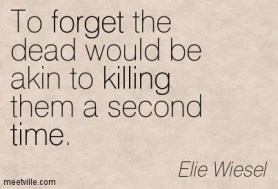
Today is Yom HaShoah

Night

One year when I was a 10th grade teacher, my colleagues and I built a heck of a unit around Elie Wiesel’s holocaust memoir, Night.

We were so proud of that unit as we planned it. The novel was the centerpiece. Then there were ancillary short stories, movie clips from Band of Brothers, Schindler’s List, The Devil’s Arithmetic. We wrote quizzes and essay prompts that mimicked the exit exam. We made photocopies and lesson plans and a culminating project. We prepared profiles of real Jews who had experienced the Holocaust to pass out to the students, and on the last day, we would tell them if their person survived or died. We stole that idea from the Museum of Tolerance in Los Angeles.

We made it as thoughtful and authentic as we could. Then we set out to teach it.

That first year, I was pregnant with Gabe and I skipped the part with the babies. I skipped a lot of stuff that year, because I just couldn’t.

The second year, I made myself sit with it. That was the first year I got a parent phone call about the book, a mom concerned that the story was affecting her student too deeply. Does it have to be THIS book? I was right there with her. I didn’t skip the part about the babies and I had a baby at home.

I also had nightmares.

The third year, I was pregnant with Kate. This was the year we decided to mix up the movie clips, so I sat at home one Saturday and watched The Pianist and Sophie’s Choice, back to back.

Keep the baby quiet.

A son and a daughter. Choose.

I didn’t sleep for two nights.

That year, I cried when I read the part about the babies. I cried when I read the part about the hanging. I cried when we watched the clip in The Devil’s Arithmetic where the mother refuses to leave the baby she has birthed in secret and they are sent together to the gas chamber. I hugged the student who laid her head down on the desk and sobbed. I didn’t write referrals when kids said “That’s fucked up” in class or when a young man stood up in class, threw his book across the room and said “This book is fucking stupid” after we read the part where the son steals food from his own father and leaves him to die.

But when the unit was done, I asked to be transferred out of tenth grade. I couldn’t do it anymore.

Last week, I saw a picture on Facebook of a teacher friend. Her students were all crowded into a small space—the size of a boxcar. She was standing on a desk over them, reading from the book. They’re still doing it, I thought. God bless them.

I get how this sounds: Like we’re all snowflakes who can’t handle the truth, melting at the first suggestion of genocide. Protect the children from this history. Teach it to them, but don’t teach it, teach it. Don’t read about ten year old boys taking three hours to die from hanging while other ten year old boys watched. Don’t talk about babies ripped from their mother’s arms and thrown alive into a bonfire.

We’ve come so far, that mom told me. Do they really need to be exposed to the horrors when we’ve made sure as a society it will never happen again?

There it is. That right there is why we taught the book in the first place, why we built such a confrontational unit, why we created a place for the kids to sit in the bald faced truth of what happened.

The danger of being 80 years away from something is that we think we have the luxury of choosing to pass the information on or not.

We don’t.

Look around the world today. Hatred lives. And not just There. Here. So high school English teachers all over this nation pick up that book every year and walk through the horrors of the Holocaust with a new group of students so that the kids will know.

Today is Yom HaShoah, Day of Remembrance. We can remember the victims of the Holocaust and pray for the peace and repose of their souls. We can ask forgiveness in the name of our ancestral family and friends who did not know or did not do enough. We can pray for generational healing.

And we can all make sure our kids know—at whatever level is appropriate for them—that when we don’t love each other enough, when we don’t remember that there is no such thing as other people’s children, when we see the world as us vs. them, we invite Evil to walk among us.

Resources for parents and teachers

United States Holocaust Memorial Museum

Museum of Tolerance

My Girl Martha

IMAG0132

Two Sundays ago, the Gospel reading was the Lazarus story from John 11. It’s only glancingly about Lazarus. He died. They buried him.

It’s more about Martha, who came running out to meet Jesus and speak some truth right at Him: If you had been here, he would not have died, which is a conversation we’ll be having later. Right now, you can fix this.

She barely waits for an answer before she gets Mary up and sends her out. She readies the folk. This is Martha. She’s a doer. This is her Messiah and she knows he’s going to do something to make them all feel better. She trusts him.

Mostly.

Because the next thing Jesus says is “Open the tomb” and that is one step farther than poor Martha is prepared to trust.

She points out the obvious, in front of a crowd no less: “Lord, by now there will be a stench. He has been dead four days.”

Or in the Douay-Rheims: “Lord, by this time he stinketh.”

Some people may wonder what Martha was thinking, calling out Jesus in public. Not me. I know that Martha was wondering what Jesus was thinking.

Martha is my favorite Bible lady, the worker bee, acts of service, everything’s under control half of the sisters who were so close to Jesus in his ministry. I relate to Martha. Every time we read the other Martha story, in Luke. I always mutter under my breath in stubborn solidarity “Sure, I’ll sit down and listen but don’t complain to me later when you’re hungry and there’s no food.”

I relate to Martha’s flaw as well—her desire that her plan be God’s plan, instead of the other way around. I get it. I do it. I even think it’s reasonable sometimes.

Why can’t my way be His way, if we’re headed to the same place? Why can’t we follow my directions instead of his?

The answer is a hard one to stomach for Type A gals like Martha and me: It’s because the big picture is BIG, too big for us to see. Jesus raised Lazarus from the dead that day in preparation for what was to come: his own death and resurrection.

Jesus loved Martha. And he loves me and all my fellow worker bee, acts of service, everything’s under control sisters and brothers. I know this because he gave us Martha, in the Gospels of Luke and John, so we could see for ourselves that it isn’t wrong to question with an open and honest heart. Only to not listen to the answer.

And can I just say that for me, if there was any doubt to the claim that Jesus was the Son of God, it evaporates in the moment Lazarus walks out of the tomb and Jesus doesn’t cut Martha some side eye.

That is SUPERNATURAL self-control right there.

My Babies Are Your Babies Are My Babies

“We can’t restore our civilization with somebody else’s babies.”  Steve King

I have grown.

I used to fear and pray for and love over only my own children. For so long, that was my measure of personal well-being, if my own babies were healthy and happy.

My world was small because I was so scared. And I was scared because my world was so small.

Once I saw it, I fought hard to spread my net of love and prayer farther than just my own babies. And when I did, when I reached out my hands in benediction for more than just my own, my world got bigger. I touched hands with other mamas, spreading their light of prayers and love outward over more than just their own too, and my babies got safer.

My babies are your babies are my babies.

There’s a responsibility here though. To feel the pain. To stand in solidarity with the mothers who have lost.

Who are losing.

Are fighting.

Hiding.

Fleeing.

Searching.

Grieving.

No matter their color, country or creed.

“There’s no such thing as other people’s children.” Hillary Clinton

cropped-img_20150201_154100.jpg