The Lost Women of the Middle Ages

(#5 in a series)

*In this chapter, Barr asserts that Mary Magdalen is the same as Mary of Bethany, sister of Martha and Lazarus. The medieval church believed this as well, thanks to a sermon by Pope Gregory the Great in the 6th century. Since then, Catholic biblical scholars have found more evidence to support that they were not the same woman and in the Catholic church, we tend to draw a line between the Marys (Mama Mary, Mary Mag, Mary of Bethany) as a way of making the point that Jesus purposefully included women in his ministry*

Mary Mag was a prominent figure in all four Gospels. She does not fear the Romans. She is present at the foot of the Cross. She is the first to see the risen Lord. She is the first one to whom he speaks. Barr calls her “the apostle of the apostles”(82) since it was she who carried the good news of Jesus’ resurrection to them.

There is precedent in the Old Testament for the role she plays in the life of Christ: loyal like Ruth, strong like Esther, patient like Hannah. These are the women God consistently puts in front of us in the Bible. They are Proverbs 31 women—grounded, faithful, taking care of business, helping others.

The Medieval church revered these biblical matriarchs. Barr writes the church “was simply too close in time to forget the significant roles women played in establishing the Christian faith throughout the remnants of the Roman Empire” (88). While patriarchal and classist, the medieval world was still an “all hands on deck” existence and the role of women was clear: CEO of the castle, with the keys to fit every lock hanging down her skirt; midwife; healer; weaver; grower; alewife, abbess. We think of sending widows or spinsters to the “nunnery” as a medieval banishment, but convents were safe havens for widows, the abused and young girls who would otherwise be used as pawns in war and politics. Women in convents learned to read and write, and from this tradition we have four of the Doctors of the Catholic Church, among whom we count St Augustine and St Thomas Aquinas: St Hildegard de Bingen (b. 1098), St Catherine of Siena (b. 1347), St Teresa of Avila (b. 1515) and later, St Therese of Lisieux (b. 1873). Their works were and are widely read and taught within the Catholic Church.

And then there’s the Golden Legend, a 13th century book about saints by Jacobus De Voraigne.

If you’re familiar with the lives of Catholic saints, then you know they can be a bit…fantastical.  Especially the early church through the medieval period. Take for instance the story about St Martha—in the medieval version, she accompanied her sister Mary Mag/Mary of Bethany to France where, as Mary was preaching to the people, Martha encountered a dragon eating a man on the beach. She “sprinkled  holy water on the beast, confronted the demoniac creature with the cross and calmly tied it up”(83). Then she took it into town where the folks stabbed it to death and declared her their heroine.

This sounds like the Martha of the Bible—practical, capable, focused. Martha was a Proverbs 31 woman who handled her business. Look closely at the words she speaks to Jesus when he arrives too late to save her brother in John: Lord, if you had been here, my brother would not have died. A statement of fact. Then she says [But] even now I know that whatever you ask of God, God will give you (21-22). Martha is not suggesting. She is telling. She doesn’t think Jesus can raise her brother. She expects he will.

This is not the Martha that evangelical women know today. Barr references Sara Mae’s 2016 book Having a Martha Home the Mary Way: 31 Days to a Clean Home and a Satisfied Soul: “Mae includes ‘Mary challenges’ to encourage the spiritual development of women and ‘Martha Challenges’ to inspire women to clean different parts of their home” (81-82).

Martha and Mary Magdalen are not the only women honored in the medieval church who have been de-emphasized in the evangelical church today.

St Paula (b.347), who left her children to answer God’s calling and helped translate the Vulgate.

St Lucy (b.283) who dedicated her virginity to God and stood firm, refusing to marry; as punishment, her eyes were removed, and she is often pictured carrying them on a plate.

St Margaret of Antioch (d.304) who dedicated herself to God, and was imprisoned for refusing to marry a Roman governor. She was attacked by a dragon in her cell, who ate her. Margaret stayed calm in the mouth of the dragon, prayed for God to save her, and the dragon exploded, setting her free (79-80).

St Genevieve of Paris (b.422), who through a “prayer marathon” is credited with saving Paris from the Huns and converting the city to Christianity.

St Brigid of Kildare (b. 451) famous for the miracle of the never-ending butter and her great spreading cloak, and a foundress of multiple abbeys in Ireland.

All of these women—and this is just a small sampling of the lives of women saints—stood in defiance of the rule of men for the love of God and triumphed. Every single one. They walked in the world as role models of faith and light, and they often laid down their lives in exchange. These are the women who gave life to Hildegard, Catherine, Theresa and more.

In the Catholic church, we know them still. We honor them as men and women of tremendous faith on feast days and invoke them as intercessors in our prayers. Not in the same way we did in the medieval period, but they are there just the same.

This is not the case with Protestants. The Saints were an explicit target of the Reformation, rejected as idolatry (this is a corruption of the doctrine of Sainthood in the Catholic Church; we do not worship them. We recognize them as paragons of faith and obedience to God, and as such ask them to intercede on our behalf). They disappeared from Protestantism, and with them, a history that included women as heroes of the Christian faith.

A final point: It is worth noting that during the medieval period, the Catholic church evolved the idea of priesthood to include celibacy, and then used this to effectively exclude women from ordination, thanks to St Augustine who equated sex and child-bearing with Original Sin. The four women recognized as doctors of the church were nuns. My church was not a paragon of equality by any stretch of the imagination, just as guilty as Protestants of pushing women from leadership.

Uniquely Biblical

(This is number 3 in a series)

CHAPTER 1: THE BEGINNING OF PATRIARCHY

In chapter 1, Barr tells a story that blew my mind.

First, some background:  complementarianism is a theological view from the Abrahamic religions that places men and women in different but complementary roles in marriage, family and religious life.  Specifically, in the evangelical and fundamentalist Christian faiths: Men lead; women follow. These roles are boundaried by the belief that Adam was created first and therefore possessed the New Testament headship to which Paul refers in 1 Corinthians 11: 3; in the “Wives be subordinate to your husbands” admonition from Ephesians 5; and also by the curse that God places upon Eve in Genesis 3:16.

Historians call this patriarchy, a system of social control that evolved in part from our hunter/gatherer roots. Historically, women were/are viewed as inferior beings in terms of intellect and strength; good for birthing babies and keeping hearth and home, but not much else. The social challenge to this construct is feminism, or the belief that men and women should be treated and valued equally.

I am greatly simplifying this part for the sake of space, but first wave feminism is dated to the 19th century, and closely linked to other social justice movements of the time (abolition, temperance, child labor). It’s been less than 200 years since the “ground-breaking” idea that no human should be the property of another—and the century long push towards welcoming oppressed minorities, women among them, into the educational and work worlds, and legislating agency over their own bodies, money and children.

Back to the story: In 2006 and 2007, Russel Moore (who was at one time the president of the Ethics and Religious Liberty Commission of the Southern Baptist Convention), encouraged evangelicals to take back the word patriarchy, explaining that the term “complementarianism” had basically been a nod to political correctness. Patriarchy, said Moore, is a Biblical word.

This confused me. Patriarchy is in the Bible, but it’s not biblical. It’s historical. The Adam and Eve story doesn’t set social precedent; it explains reality for a primitive society. How else does early man process that women bleed, and have pain in childbirth? I used to tell my students “Wouldn’t you think she had made your God mad?” More critically: Eve is not the only female chaos agent enshrined in mythology. The ways of women were a mystery in the ancient world. 

Granted, my perspective is Catholic and we now recognize the first 16 chapters of Genesis as origin myth for the Hebrew people, a stance beautifully explained in our Catechism, 279-289. Barr had a more difficult mountain to climb as a literalist. Her faith requires her to accept Genesis as historical fact.  This created a dissonance between what she knew as a doctor of history, and what her church was asking her to believe: patriarchy is uniquely Biblical.

Uniquely biblical—and therefore ordained by God. This is the part that blew my mind. The Catholic church is no paragon of equality, and certainly complicit in tolerating and even extending oppressive patriarchy, but there has always been logic and sense in our theology. Women are welcome in ministry, if not on the altar. Women are doctors of the church. There is no pressure from the pulpit for women to be submissive, to stay home, to remain uneducated. I had no idea this was the doctrine in evangelical churches.

It’s an incorrect doctrine, of course. But is it wrong, or a lie? The first speaks to misinterpretation; the second to purposeful manipulation.

Barr spends the rest of the chapter explaining her path to understanding: from the Epic of Gilgamesh; to the male grad student who refused to acknowledge her authority over him in a classroom in an extension of his “headship”;  to Russel Moore’s laughable distinction between “pagan” and “Christian” patriarchy: “(W)omen should not submit to men in general (pagan patriarchy), but wives should submit to their husbands (Christian patriarchy)”; to wondering if–since patriarchy is clearly not biblically ordained but existed everywhere—patriarchal structures are actually a manifestation of human sin.

Oddly, Barr turns to the letters of St Paul for the answers.

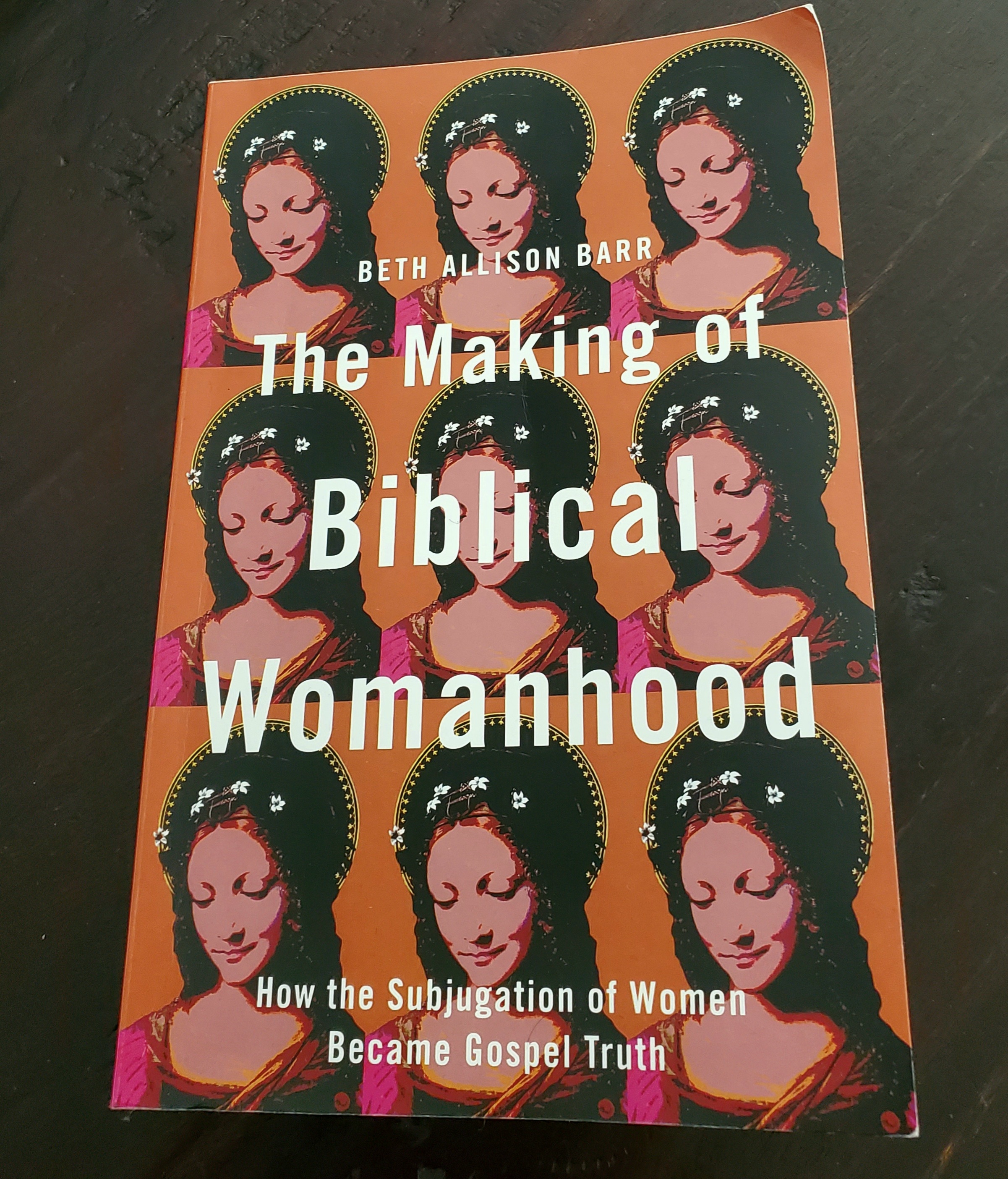
Biblical Womanhood: A Book Study

I want to tell you about this book:

There are a lot of reasons I’m reading it, firstly because my dad sent it to me marked “for discussion when we see you next”.

Also, because I am a feminist Catholic—in that exact order. I internalized my feminism before I internalized my Catholic faith, so I tend to view faith through a feminist lens. This is very different from viewing feminism through a Catholic lens, or through an evangelical one, as Barr does.

For what it’s worth, I think it’s easier to be me than her—I showed up cynical and fought the catechism every step of the way. I never expected my Christian faith to be a beautiful, life-giving shelter and was gratefully surprised to find that it is. Barr had to “wake up” to the patriarchy inherent in her evangelical Christian upbringing through her historical studies, and the resulting disillusionment shook her out of her church.

To clarify—her church is the Southern Baptists; she calls them “evangelicals” but that term feels wider and deeper than the ways she uses it to refer to a very conservative set of patriarchal, sinners-in-the-hands-of-an-angry-God beliefs. I know evangelicals who do not ascribe to these beliefs on any level, but her labels are reflective of her experience.

I strongly feel though that all women of the Christian faith have things to learn from this book and the ways in which womanhood is reflected in the Bible. Most of us know what we’ve told, sitting in the pews, or in Sunday School classes, and we accepted it. How many of us have taken a deeper dive into the history and context of the Bible, or the 2000 years of clarification and scholarship that exists to help us know and understand the word of God? How many of us really process that every Bible we hold in our hands has been translated, or questioned who does the translating? Clicked the “About” tab on websites for seminaries where our priests and pastors are educated? Or asked ourselves “Who is telling this story, and what do they have to gain from telling it this way?”

I’m not an expert but I can teach anything. And I’d like to walk this you. Eight Chapters. One a week. I hope you’ll join me.

In My Bones

I’m on my walk. It’s a 3 mile trail on a hill. There’s a huge section on the downhill that runs along what I think of as “the bracken”—wetlands-y, bordering the woods, lots of overgrowth.

Just as I enter the bracken, I see a man coming towards me. He’s about a football field away, which starts my heart racing because it’s not much time to plan.

Plan what, you ask? Ha! No you didn’t, because you’re mostly women here. You know exactly what I meant: I’m alone and here comes a man.

My first thought was I didn’t bring Dasher. Not that Dasher would save me from anyone, but only our family, friends, contractor, the pool guy next door, our neighbors and the kids down the street know that. To everyone else he looks like a German Shepherd tied one on with a Doberman. But I didn’t bring him with me today.

This is the moment I take a good hard look at the bracken to my right. Which, hey look at that, slopes downward. How have I never noticed that before? One good shove, and I’m off the path and into the blackberries. No one would ever know.

I’m not helpless, though. I can see him coming. He’s wearing sweats, a hoodie and sunglasses. I remind myself to strike for the soft spots. Then I sink into my feet, ready.

YOU GUYS. I am just walking on a Monday morning at 9:00 am in my own town, but I now have a plan for the man who is walking towards me on the path.

And it is only because of what he does next that I even spend one second of my day unwinding this moment.  

With at least 20 feet to go before we meet up, he swings wide off the other side of the path, putting a good 15 feet between us as we pass. I am so flummoxed by this that I actually think “Bit much, COVID dude” before I realize he did it to make me feel safe.

It shocks me. I’m not scared of much, but as I let go of all the ways I prepared to cross paths with him, I know that the threat I felt is ancient and generational, bred into my bones and reinforced by 49 years of living. Women are not always safe alone with a man. Vigilance is required. It has nothing to do with this particular man and he knows it, because he has a mom, wife, sisters, daughters. He doesn’t take it personally. But he does move to make me feel safe.

I’m telling you this thing that you already know as women because maybe we have forgotten that other people have ancient, generational instincts bred into their bones too, from other threats that also require vigilance.

We need to remember. We need to give people space for their vigilance, acknowledge that the vigilance is legitimate, and then earn each other’s trust. It’s not asking too much. It’s how we begin to fix what’s been broken.

It was the work of 10 seconds for that man to make me feel seen, respected and safe. We can do this for each other.

Did You Make Space for a New Creation?

We are coming out of a hot, spicy nightmare right now into a new creation.

Are we ready?

We should have been making space–space in our souls, space in our hearts, space in our time and relationships and jobs for the new creation that we are promised to flood into our lives.

Don’t tell me nothing really changed in the last year. How could that even be possible? All those prayers you threw up for time to fix and heal and get healthy and God gave you a year. You used it, right?

And even if you didn’t, you will, because we are not ruining the new creation with the old crap.

Let me give you some examples.

You know that side of the family you hate to see because they drink too much or they’re mean or racist or belligerent or their kids suck but you always invite them because…family? Well you haven’t seen them in a year, haven’t missed them and the basic family structure is still intact. Are you going to go back to loud, angry, drunken Thanksgivings? Heck, no. We don’t ever have to do that again.

How about that passive aggressive friendship with the mom from school where you hang out more because of proximity than kindred spirit and she makes you crazy anyway? Are you going back to weekly gossip coffee dates? Nope. Sorry, my schedule has changed and our kids have moved on. See you around.

How about money? Did you cut back on all the things to save money during job furlough or loss? When the jobs come back, are you just going to go back to living paycheck to paycheck so your family can have all the things again? No–we have a future to plan for. We lived without a lot this year and didn’t miss most of it.

What about that job that you now know you can do from home, and better. Are we going back to giving our whole lives to our jobs, working an 8, 9, 10 hour day because someone 70 years ago decided that was necessary and showed initiative? Thank you, no–we’re going to negotiate something better.

What about your kids and school? Was distance learning a relief for them? Like water on a thirsty plant, did it cause them to grow and blossom? Then are you going to send them back to the way we have always done things? Of course not–we have empowered our kids to learn from home.

(Not mine, though. Mine need to take all that angst and energy, walk right out the front door to the bus that will take them to the school where the person who manages all that angst and energy is well-trained, well-prepared and not me)

Are you going to pass that holiday phone from granny to auntie to uncle to cousin so everyone gets a chance to talk to the family out of state on Christmas? No way–you’re going to fire up that Zoom meeting, cast it onto the big screen and have dessert together from 2000 miles away.

We are going to live stream football games and volleyball games and plays and concerts and recitals. We are going to live stream church services and baptisms and First Communions and weddings and funerals. Being forced apart taught us how to be closer, it pushed us past boundaries we didn’t even know we had, it made us innovate. And it is just the beginning.

The sorrow and struggle were real, as were the cost, which has been folded into our collective subconscious. We cannot forget the lessons the last year have taught us.

But the new creation is here and it is God’s Providence, to make all for our good. We just have to put away the things of yesterday, open the door and step out into the light of a new day.