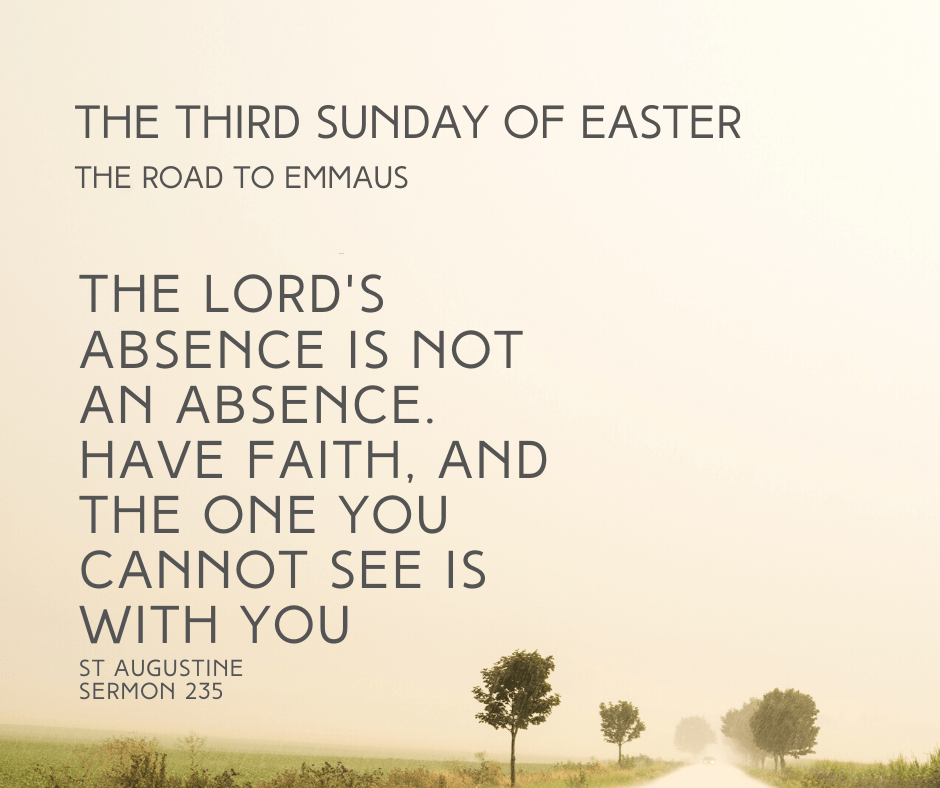
On the road to emmaus

Remember Easter Sunday morning, when Mary Magdalene met Jesus at the tomb and didn’t recognize him?
Today’s gospel also happens on Easter Sunday, just later in the day. Many scholars agree that the travelers were Cleopas (named in the Gospel) and his wife, Mary, who was noted to be at the foot of the Cross with the other Marys in John 19.
Perhaps they were traveling home, steeped in pain. Jesus has been killed and now his body is gone. They’re scared, exhausted, angry, and sorrowful. Cleopas says that Jesus’ death has robbed them of hope: We were hoping he was the one and now he is dead.
A traveler joins them–it’s Jesus, but the gospel says “their eyes were prevented from seeing him”
That got me researching. Was this lack of sight divine intervention or the limitations of grieving human minds? And if it was divine intervention–both Mary Mag and the disciples on the road to Emmaus were purposefully prevented from recognizing Jesus at first–what purpose does it serve?
Turns out, most folks who know think their eyes were purposefully veiled. St Augustine acknowledges that grief may have played a role, but that ultimately it doesn’t matter why they didn’t see him. 
The lesson is in the NOT seeing.
Mary Mag doesn’t “see” him until he calls her name. Cleopas and Mary don’t “see” him until he breaks the bread.  But he was there all the same. 
That is the gift of this Gospel, and what a gift it is–Jesus himself teaching the lesson that He is always here.  He calls us by name to know him. He is present in the breaking of the bread and therefore present in us. He is the kindness of a stranger and the safety of a meal with those we love. 
Grief, fear, anger, pain–these can all veil our eyes and make us feel abandoned and alone. Today’s Gospel teaches us to trust in the Resurrection and the promises of Christ.

A Few Words About Voting, To My Christian Friends

Most of us are regular folk, just trying to carve out a connected, contented existence in this life. Our voting values reflect this desire. I am prolife, as my church dictates, from natural conception to natural death. This means that I am anti-abortion, anti-war, anti-euthanasia, anti-death penalty. It also means I support extensive and immediate environmental reforms, affordable healthcare, government assistance, open and just immigration laws, social security, medicare, public education, civil rights, equal rights and paying my fair share of taxes to help this nation function.

I bet most of you are a lot like me, with a wobble to the right or left on certain issues. Which means you’re in the same pickle as I am—it’s damn hard to vote.  The candidate who reflects my values does not exist.

How do we vote? Historically, my church has encouraged me to value the sanctity of the unborn as primary to all other life issues. But the anti-abortion candidate is not always pro-life, sometimes glaringly.  Also, abortion rates are down and the threat to the environment is universal.

This is where Bishop Robert McElroy of San Diego entered the conversation in a speech he gave in January.

You can read the whole thing—but here’s how he breaks it down:

Life issues ARE primary. And after years of doing not enough, the threat to our environment (and therefore our very existence) is equal to or more threatening than the evil of abortion. They must be considered equally.

But since the candidate who will legislate as both anti-abortion and pro-environmental reform does not exist, we have to add the other life issues to the scoreboard: abolition of the death penalty and euthanasia, open and just immigration and refugee reform, protection of worker’s, civil and religious rights, assistance for the poor and hungry, promotion of marriage and family, nuclear disarmament and the protection of religious liberty.

Even this is not enough. We do not vote issues or parties into office, but people. We cannot afford to ignore the person for whom we cast the vote, no matter how aligned we are with their politics. And this consideration is three-fold.

First, we must admit that our national discourse is dysfunctional, and as a result our government has done very little good in the name of all Americans. Our nation family requires healing, which in turn requires compromise. To true patriots, who believe in the rights of all Americans and not just their own interests, it then becomes essential to select a bridgebuilder, someone who can reach across the divide and craft collaboration.

Second, they must have the same principles we try to instill in our children: truth, integrity, honor, discernment and reflection. These principles are demonstrable, and should therefore be evident.  

Third, they must be competent: Mentally, emotionally, spiritually and in statecraft. They all have resumes. It is our responsibility as moral voters to research our choices.  

This can work. Even though it may mean voting for someone with whom I do not completely align—by using these guidelines, I can make a better, more faithful decision.

Lastly, we have to refuse to participate in the spectacle. When John McCain and Mitt Romney were running for President, they were running against my candidate and, caught up the rhetoric and vitriol that is our national election, I saw them as other and enemy. Although I know that my votes for Barack Obama were faithfully sound, in hindsight I see that either of these men would have also made fine leaders, by Bishop McElroy’s standards and my own. Our presidents and presidential candidates have not always been persons of integrity, but we know what men and women of integrity look like. They build bridges, unite others, seek compromise, speak truth, reflect, apologize and are humble enough to admit they do not have all the answers.

This soundness of soul and spirit is what we should seek in a leader, and what we deserve from someone who earns our vote.

“Good Grace” by Hillsong United

You know when you hear a song and all the hairs stand up on your head? This one.

Maybe it’s because I am feeling grateful beyond words that my friend and her family escaped disaster last week when their home caught fire. Maybe too, at the love they have been shown since. God is good. People are good. Life is good.

Still. Somebody needs this today.

If it’s not you, you know someone. Tell them.

So don’t let your heart be troubled
Hold your head up high
Don’t fear no evil
Fix your eyes on this one truth
God is madly in love with you
So take courage
Hold on
Be strong
Remember where our help comes from

Play it LOUD friends. Love is all around us.

Fourth Day

wpid-img_20140814_160137.jpg

Today is the Fourth Day. Yesterday we were born again into eternal life and today is the day we begin to live like it. That’s why I want to tell you what I learned during this Lent.

I gave up 24 hour news channels.

I did it because I have watched people I know slide into anxiety bordering on mental illness over the last two years from watching these channels.

I did it because of how many times in the last six months the hot take has been wrong and caused massive social upheaval.

I did it because a friend told me she hoped her bro-in-law had been able to drag her sister away from CNN for her birthday.

I did it because these channels are an echo chamber. We watch the one we like the most and all they tell us is what we want to hear.  That’s disturbing on so many levels—but the one that disturbs me the most is that viewership is UP on these channels as we all align ourselves for 2020.

I did it because when the lady from Church called to tell me “Turn on  Fox News!” because Notre Dame was on fire, even after 40 days of not watching any of them, I thought to myself “I know something about you now.”

I did it because those channels are not reporting news. They are opining, which is not news. And they are opining for money which means their integrity is questionable at best and non-existent at worst.

I did it because I have noticed that people who watch these channels have lost their faith in humanity and joy in life. They are always angry, always accusing, always ready for a fight.

I did it because that was me.

I think it was probably the best way I could have spent my Lent and I am not kidding.  I learned something gnarly about myself:  how often I turned on those channels to get my “I’m right” validated.

I’m not going back. A little bit of distance has taught me that these channels want us to worship them, submit to them. And a lot of us have done it, especially the ones of us who work from home or at home or are retired. These channels are the noise running in the background of our daily lives—but what is it costing us?

Our sanity, if you ask me. Our kindness. Our faith in each other. Our faith in God. So many of us are scared, and faith-filled people aren’t scared.

You know what I’m not since I stopped watching? Scared. Angry. Suspicious. I’m not sure the world is going to hell in a handbasket. I’m not anxious.

I see love and light in the world. I see kindness and joy. I see work to do, for sure. But it’s not dire. It’s not endtimes. I believe in our ability to climb this mountain together because there is glory and goodness all around us.

All around us.

Turn them off. Just trust me and turn them off.


Into the Desert–A different way to think about Lent

I have always tried to find a better way to come at Lent with my kids.

This year is no different, as we are 1 day out and Annie is settled on giving up the monkey bars.

God bless her little heart, she loves her some monkey bars.

It’s probably too much to expect a 7-year-old to be reflective, but Gabe and Kate are now old enough to learn something from Lent.

And the idea of a token “sacrifice” of chocolate or cursing for 40 days has left me wanting more. Maybe because it was always presented to me as a small thing compared to the sacrifice Jesus made on the cross.

But what if that’s the wrong way to think about it?

Nothing I can do will ever match what Jesus did for me.

On Sunday, a solid catechism Bible Scavenger Hunt from my partner teacher Megan dropped a new way to frame Lent into my lap.

All three of the Temptation stories in the Gospels tell us Jesus went into the desert after his baptism to prepare for his ministry.

Why the desert? If the goal was solitude, why not a boat on the sea for forty days? Or a trek into the mountains?

Why the desperate, relentless austerity of the desert?

Yes, it calls back to the forty days Moses spent on the Mount before receiving the Ten Commandments and the forty years the Israelites wandered after their escape from Egypt. Jesus is tempted by the devil in the desert and refutes the temptation, staying faithful to God, in contrast to both Adam and the Israelites. There’s a whole world of theological scholarship out there about these forty days.

But I’m just a mom in front of a laptop trying to figure out a way to grow faith in my kids, so I’m going with a boots on the ground application: Jesus went into the desert so he could focus.

In the desert, there are no distractions.

We are running with that this year: Focus—not on what we’re not doing, but on removing the distractions that turn us away from our relationship with God. Making our lives more like a desert for the next 40 days.

Pack up the toys, clothes, stuff that surrounds us. Clear out the clutter. Save money by forgoing nights out, expensive dinners, new things. Use less words, especially of the cursing and gossiping kind. Spend less time online wanting what we don’t have, or what someone else has. Spend less time watching news that is designed to scare, addict, divide. Reject all the ways we are tempted, as the devil tried to tempt Jesus, by the things of this world.

Practice simplicity. Prayer. Contemplation. Fasting.

Listen for the angels who will minister to us.

Open our hearts and hands every day to the word and will of God.

This will be our Lent, our walk in the desert. I’ll let you know how it goes.

Then Jesus was led by the Spirit into the desert to be tempted by the devil.
After fasting forty days and forty nights, he was hungry.
Matthew 4:1-2